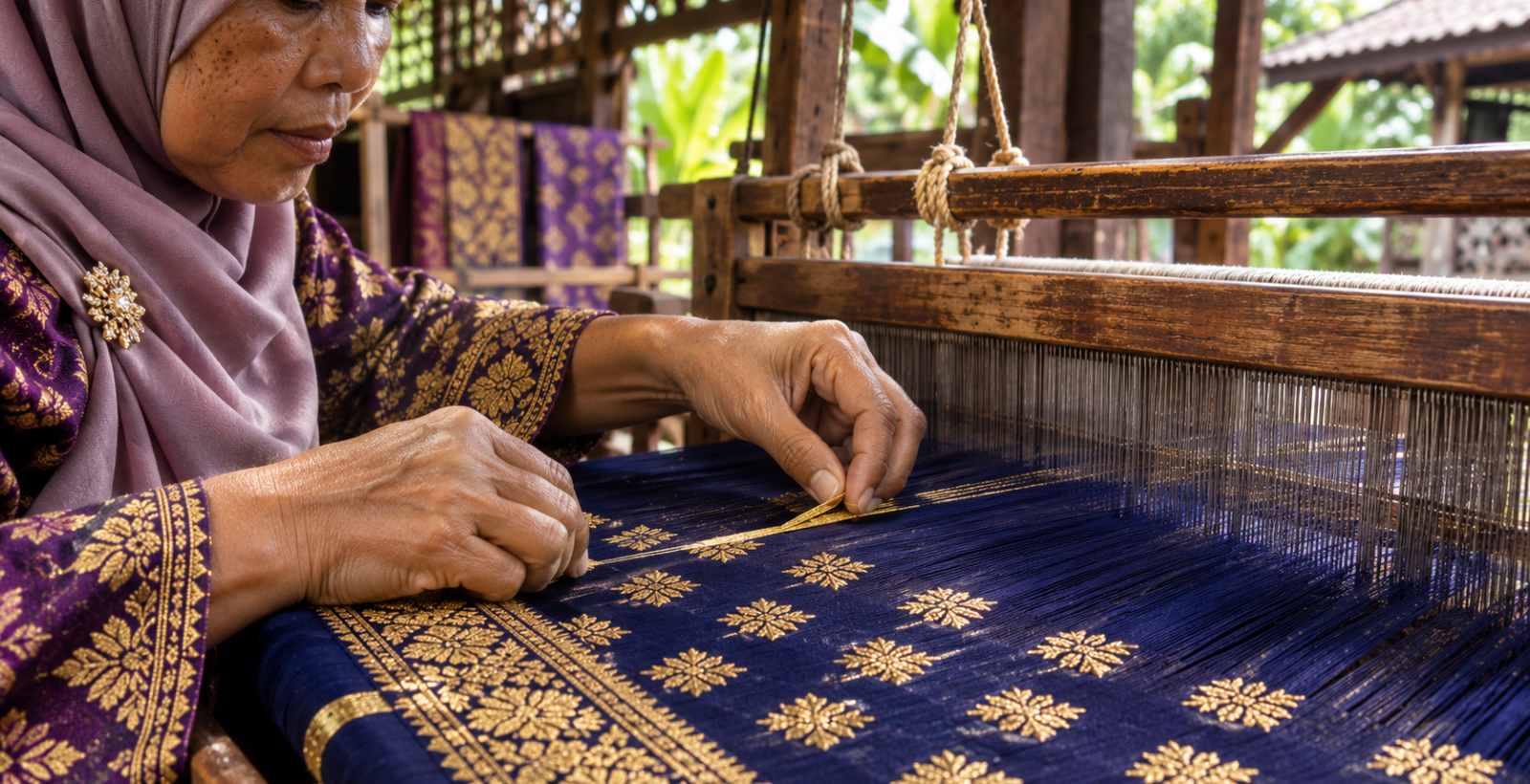
Tilt a piece of songket towards the light and its motifs catch the eye before the background cloth does. Look closely at the edge of a motif and you can see where the decorative thread passes over and under the base threads. The pattern takes shape on the loom as the artisan weaves.
A pattern made with extra threads
The lengthwise threads on a loom are called the warp. The crosswise threads are called the weft. In songket, the weaver adds extra decorative weft threads, often gold or silver in appearance, in selected places. Those threads pick out the motif against the background cloth. A traditional floor loom used in this craft is called a kek.
The craft behind the occasion
Songket was historically associated with royalty. Today it is also worn at Malay weddings, festivals and formal occasions. Geometric patterns sit alongside motifs inspired by flowers, birds and other elements of the natural world. Skilled weavers in the Malay Peninsula and Sarawak have passed on the techniques across generations, and UNESCO inscribed Malaysia’s songket tradition on its intangible cultural heritage list in 2021.
If you see songket at a wedding or in a textile gallery, follow a single motif from one edge to the other. The repeating points where the decorative thread surfaces show how the artisan built the design across the cloth.